Wednesday, January 26, 2011

January 30, Epiphany 4, Who's Big in the Kingdom of Heaven


Micah 6:1-8, Psalm 15, 1 Corinthians 1:18-31, Matthew 5:1-12
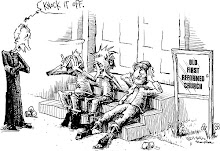
(And that's a picture of my favourite theologian. It's a Christian epic, you know, which is why the movies are so bad. No love of trees.)

This morning’s gospel is the beginning of the so-called Sermon on the Mount. It takes up three chapters in Matthew. It’s a compilation and digest of all the preaching that Jesus had been doing in all the village synagogues. Now he takes it outside, and addresses the population as a whole, evoking when Joshua addressed the whole population at Mount Ebal. Because the people want to know. If the kingdom is at hand, what are its laws going to be like? What’s going to be expected of us? What people will be favored in it? What kind of fish should these fishers of men bring in?

Jesus opens with this passage we call the Beatitudes. It’s almost a poem, and it has subtlety and play in it. It’s often misunderstood.
First, it’s not a list of discrete definitions of certain kinds of people. It’s a unit, to make a whole and rounded picture.
Second, it’s not about who goes to heaven after you die. It’s not an opiate for the poor, because they’ll be happy up in heaven. Jesus has been saying that the kingdom of heaven is at hand, on earth as it is in heaven, it’s already here and now with him, wherever he is.
Third, it’s not that it’s better to be poor than rich or to be meek instead of powerful. It’s that wealth and power do not have any of the results or privileges that we want wealth and power for. You know the old joke: the best thing about being rich is all the stuff you get for free. Not in this kingdom.
Fourth, it’s not that the rich and the powerful are even excluded from this kingdom, but it is that they are not the ones who have the honors and the privilege they’re used to. The rich and powerful are welcome if they take their place behind the poor and the meek. This policy is what St. Paul calls the foolishness of the cross.
Let’s take a look at the Beatitudes more closely. What the Greek word behind "blessed" means is actually "honored".
Blessed Are /// For
the poor in spirit /// >theirs is the kingdom of heaven
those who mourn /// they will get comforted
the meek /// they will inherit the land
hunger and thirst /// they will be satisfied
for righteousness
the merciful /// they will get mercy
the pure in heart /// they will see God
the peacemakers /// called children of God
those persecuted /// >theirs is the kingdom of heaven
for righteousness

Blessed Are You /// For
when persecuted /// >your reward is great in heaven
rejoice and be glad /// you share prophets’ persecution

Look at the upper two-thirds. On the right-hand side, all eight lines belong to the kingdom of heaven. These are the things that happen in the kingdom, and the signs of the kingdom coming on earth. In the kingdom of heaven, the earth will belong to the meek, not to the aggressive and powerful. Earth here has the sense of land, or property. But the meek are never owners, they are always tenants, always paying rent, always last on line. In what kind of economy do the meek inherit the property?

On the left-hand side, the phrase for righteousness is doubled, so this kingdom highly values righteousness. Righteousness divides the eight lines into four and four. The second four lines are a mirror-image of the first four lines. The poor in spirit get served by the merciful, and those who mourn get served by the pure in heart, and the meek require the intervention of the peacemakers, and those who hunger and thirst for righteousness will find themselves persecuted. Because this kingdom is not separate from the world, but always in the world and in tension with the world.

The poor in spirit and the mourners and the meek are those who suffer, and the merciful and pure in heart and peacemakers are those open themselves to the suffering of the world. Like Jesus himself. You can’t afford to do that if you’re competing hard, or out for number one. But the kingdom is set up to honor those who live this way, who do justice, and love kindness, and walk humbly with their God.

It’s impossible. I give up on righteousness and justice. No, you will be satisfied. Only this, you will be both satisfied and resisted, and even persecuted. You will discover, that as long as you live in this stage of the world, do justice and righteousness will cost you. Peacemakers end up poor in spirit and mournful. Who can dare to live this way? How much do you desire it?

Please understand that it’s not that the left side causes the right side. It’s not that your being poor in spirit will earn you the kingdom of kingdom of heaven, and that being meek makes you more worthy of your property. He’s not saying to be merciful in order to get mercy back. It isn’t cause and effect, he’s not saying what goes around comes around. What’s on the right side is a gift of God, is what God does, God is the king who makes the kingdom come, and it’s for us to receive it. The only advantage of the poor and the meek is that they have less of worldly value in the way to keep them from receiving it, and that only advantage is everything. When we are these things on the left, we are right square in the path of what God is doing in the world and are open and ready to see God in the world.

The kingdom of heaven claims the very same territory as all the nations of the world, and it has a very different set of weights and standards. We must learn to see mercy and meekness and mourning in a different way than this world does. We can learn to see these and practice, we can, and this is what we teach each other and encourage in each other.

It’s because these things are very serious that I want to end a little playfully. A group of us were talking about the Lord of the Rings. I have not seen the movies, but the books were formative in my life; I was what they called a "Tolkien freak." The great theme of the book is that evil empire of the Dark Lord Sauron was defeated not by all the powerful armies and horses and riders of the noble kingdoms of Gondor and Rohan, but by the weakness and meekness of two little Hobbits. What St. Paul calls the foolishness of the cross. Not that we should all be Hobbits. But that the ones who are honored are those whom the conventional wisdom discounts and disregards.

Schuyler Orr is going to be baptized today. Schuyler is a little person, but he is not a Hobbit. He needs to grow to his full size and the empowerment of his potential. But what we owe to Schuyler is a community that believes and models the value and the honors and the weights and standards of the kingdom of heaven, with sufficient conviction to help him face the resistance of the world for the rest of his life, and even its very subtle persecution, and not to face it with anger and resentment but with love. He can love because what he lives by is a gift. Salvation is a gift of God. He can’t earn it, he doesn’t own it, he needn’t defend it, and he can’t lose it. We live our whole lives by the grace and gift of God. Salvation is by grace through faith, not anything that we can do that we might boast of. But we can honor it in Schuyler, and we can help him to believe in it. In our life together in this congregation we can help him to see God, yes, we can help each other to see God.

Copyright © 2011, by Daniel James Meeter, all rights reserved.

Thursday, January 20, 2011

January 23, Epiphany 3: On the Shore and In the Hills


Isaiah 9:1-4, Psalm 27:1, 4-9, 1 Corinthians 1:10-18, Matthew 4:12-23
Jesus moved out of his home town of Nazareth, up in the hills, and rented a house down at the lakeshore, in Capernaum. Imagine Jesus in his house: in the mornings doing carpentry, making furniture for the merchants, or going out to frame houses for Gentile settlers. He makes his mid-day meal, takes a nap, and then he goes out for his walk. He loves to be out among the people. He likes to walk along the lakeshore. One afternoon he comes back from his walk with four other men. They sit down in his front room, he makes them all coffee, and they talk. More coffee, more talk. Late that night, they go back home. I wonder, how many days a week do they come back? How much do they keep fishing, in order to feed their families?

On Fridays they go with him up into the hills. Every week another synagogue, arriving at sundown, repeating the prayers with the people, socializing overnight, going to service on Saturday morning, preaching and teaching, getting invited for coffee, healing the people, then still more coffee, and then walking back downhill, and home to Capernaum.
The campaign platform was the same as John the Baptist’s. "Repent, for the kingdom of heaven has come near," but the emphasis was more on the second part. For John, you had to go down to the water and repent, to get clean and ready for the kingdom soon to come. With Jesus the kingdom has come, ready or not, and he was taking it up to the people, in their ordinary lives, and just to accept that kingdom is the same thing as repentance.

In their villages, not in Jerusalem. In Galilee, not in Judea. In the Bronx, not in Manhattan. In the north, in the region that Moses had assigned to the tribes of Zebulon and Naphtali, a region that had always been a battlefield, one army after another marching through, pillaging their crops and ravaging their women. A region of Jews in poverty, and of Gentile settlers controlling the means of production. The Jews were in depression, and they felt like exiles in their own land.
The Jewish revolutionaries, the Zealots, had their headquarters in Galilee because it was more open and less controlled than Judea. Jesus had more freedom here to develop his campaign. Had he stayed in Judea, and announced in Jerusalem that the kingdom of heaven was at hand, he would have would been arrested with John the Baptist. But Galilee was also a better venue for Jesus’ new version of the kingdom of heaven. He didn’t bring it as a kingdom of independence, but a kingdom of interaction. It’s not for ridding our life of enemies, but for loving our enemies close at hand. It’s not for isolation but engagement. It’s not for getting rid of troubles, but for dealing with our troubles. The kingdom of heaven is for the mixed-up reality of our lives.

And to join him in his campaign he didn’t call priests or scribes or soldiers, but ordinary working guys. This was not the first time that he called them. Last week we read of the first time he called them, in the Gospel of John. They were down in Judea, standing beside the Jordan River, disciples of John the Baptist. And then when John pointed out Jesus to them, they went to him, and began to follow him. Then there was a gap. John the Baptist got arrested and his campaign was dispersed. The disciples went back to Galilee to fish. And now a second time they’re called, but instead of their looking for him, he comes to find them, right in the midst of their ordinary lives. And now they have to balance their fishing with the immediacy of discipleship.

Following Jesus is not magic. It’s usually gradual, in fits and starts, with gaps and hesitations, and with doubts and disappointments. It happened in stages that Peter and Andrew became disciples. That’s how we experience it. Following Jesus is rarely a sudden simple thing or one nice gradual evolution. You get an experience where you really take notice of God, which feels like a call. And then there is a gap, and you wonder if it was real, and if anything has really changed. Then you have another experience that takes you further, and you feel called again. Now God is asking more of you, a greater measure of devotion, God is calling on you to do something which may cost you, and you have to put down what you’re doing, and make new room in your life to keep on going where Jesus is calling. And when you think you’ve got it down, there’s more.

Jesus calls them on the lakeshore—not in the desert nor in Jerusalem. My favorite place on the planet is a rocky lakeshore up in Canada. In the summer I love to get up at dawn and just sit there for a couple hours. The lakeshore is a boundary, a limit, yet it’s not a wall, it’s an open boundary, the lake is open wide before me, and I can enter into it. And the lake is always right there all the time I’m doing whatever I’m doing on shore.

That’s what discipleship feels like to me, that’s what repentance feels like, not like putting yourself through fire or through torture, not punishing yourself, but like living along the lake, living along the boundary between two worlds, two realms of existence. The one realm is the one we’re born into and we’re used to it, where we can make our own way, thank you very much, where we don’t have to follow anybody. You make your bed, you cook your meals, you do the dishes. The other realm of existence is right there, always with you, as close as heaven is to earth, but it’s wide open, and I’m drawn to it but I’m unsure in it. When I look at this world I"m used to from within the air of heaven, the very same world becomes a different world, a strange world, in which all of my certainties are made uncertain, where all my confidence must be humility, where I need a leader and a guide, someone I can trust. And he says, "Follow me."

That’s very open-ended. I’d like to know first where he’s going. Why not just tell me where we’re going, give me the directions, and I’ll go straight there on my own? And why not just tell me what I have to repent of? I don’t mind repenting, just tell me what I did wrong, and I’ll say I’m sorry, and I won’t do that again. But Jesus doesn’t stand up in the synagogues of Galilee to say, "This is wrong, these thirty-seven things are wrong." If Jesus did that we could keep a list and check it off. He doesn’t tell us precisely what we have to repent of, he just says, "Repent," and then he says, "Follow me." He leaves it very open-ended.

Discipleship, repentance, the coming of the kingdom. These are all aspects of a single package. The kingdom is what Jesus brings, and to receive it is repentance, and to explore it is discipleship. The kingdom is what Jesus brings, and to receive it is repentance, and to explore it is discipleship. So then what is required of us?

On the one hand, everything is on the table, The boundary runs through all things. There are not some parts of life which are in the kingdom of God and other parts which are exempt. Every action, every possession, every relationship, every issue, every interest, every dollar, everything about you, everything you think or hope or say, it all belongs to the kingdom of God. The call is fully comprehensive. You must be ready to put anything down right now, from your plans to your possessions. In nothing are you self-sufficient, in nothing are you fully competent, in everything you need instruction, in everything you need healing, in everything you need forgiveness, and for everything you need repentance. Repentance as an attitude, not a self-evaluation or a listing of rights and wrongs you’ve done, but repentance as an attitude of full reception.

On the other hand, there is no stress to this. It is total but it is light. There is no pressure to this. Look how easy Jesus takes it. Look he patiently he campaigns, how much time he takes, how much room he gives. How just a little is a sign and seal of a whole new world. There is no pressure because the kingdom has already come, we don’t have to earn it or build it but receive it. You explore it by enjoying it. This is a kingdom where the law is love and the power is joy.

Copyright © 2011, by Daniel James Meeter, all rights reserved.

Wednesday, January 19, 2011

Eagle's Wings: From a John Donne sermon

This was just sent to me be a parishioner, and I love it:

Eagle's Wings. ". . . So are those words which are spoken of God himself, appliable to his Ministers, that first, The Eagle stirreth up her nest, The Preacher stirres and moves, and agitates the holy affections of the Congregation, that they slumber not in a senselesnesse of that which is said.

"The Eagle stirreth up her nest, and then as it is added there, She fluttereth over her young; The Preacher makes a holy noise in the conscience of the Congregation, and when hee hath awakened them, by stirring the nest, hee casts some claps of thunder, some intimidations, in denouncing the judgments of God, and he flings open the gates of Heaven, that they may heare, and look up, and see a man sent by God, with power to infuse his feare upon them;

"So she fluttereth over her young; but then, as it followes there, She spreadeth abroad her wings; she over shadowes them, she enwraps them, she armes them with her wings, so as that no other terror, no other fluttering but that which comes from her, can come upon them;


". . . And so the Minister hath the wings of an Eagle, that every soule in the Congregation may see as much as hee sees, that is, a particular interest in all the mercies of God, and the merits of Christ."

Wednesday, January 12, 2011

January 16: Epiphany 2, The Lamb and the Dove (for Christina Taylor Green)


Isaiah 49:1-7, Psalm 40:1-11, 1 Corinthians 1:1-9, John 1:29-42
We had our consistory meeting on Monday night. The consistory is the governing body of the church, the elders and deacons and myself. I’m always a little nervous before these meetings, because I am accountable to them, and I felt unusually vulnerable because we were discussing my salary, and also because I needed to retract some information I had given them the month before. But it was a very good meeting, and at the end we all felt very positive. We had many things to celebrate, because last year was a banner year for Old First. We want to share these things with you at our congregational meeting next week after church.

On Tuesday morning, as is my habit, I got up at 6 am to keep working on this sermon, studying the lections, trying to listen for a word from God for me to communicate to you today. At 8 am I took a break for breakfast, and turned on NPR, and I heard the latest report on the shootings in Tucson, and suddenly I found myself weeping, weeping for the congresswoman, and the judge, and the other victims, and for Christina, the little nine-year-old girl, weeping for our nation, and grieving our violence and our indulgence of our violence. I am usually inured to this, I try to be professional, but maybe I was still vulnerable from the night before.

"O Lamb of God, who takest away the sins of the world, have mercy upon us. O Lamb of God who takest the sins of the world, have mercy upon us. O Lamb of God, who takest away the sins of the world, grant us thy peace." Agnus dei, qui tollis peccata mundi, misere nobis. For many centuries the church has been singing this and praying this, especially when we face our violence and fear and misery, and the damage we do to each other and to the world.

"Behold the Lamb of God." John the Baptist was the first to say it. He was the first to identify the Messiah as the Lamb of God. Where did he get that from? That’s not what they wanted from the Messiah. They wanted a lion, a victor, a leader, not a lamb. Lambs get sacrificed, lambs get eaten, lambs are victims, lambs are like little nine-year-old girls.
I think I know where he got it from. He testifies that he saw the dove come on Jesus. He reports that he saw the Holy Spirit come down on the Messiah like a dove. That’s not what he expected. He was expecting the Holy Spirit to come down on him like fire. There were prophecies of this. The fire of holiness, the fire of power and judgment and purgation. And what the people will have wanted was an eagle, a properly royal bird, the symbol of power, like the Roman eagle, carried by the legions in their power and their victory. Eagles and lions, the symbols of kings.

The dove is a Biblical symbol of two things. In the story of Noah’s Ark, the dove is the sign of the judgment over, the healing of the world, of restoration and reconciliation and peace. In the law of Moses, the dove was a poor person’s sacrifice. If you could not afford a lamb you could substitute a dove. When the dove came down on Jesus, John the Baptist saw these things.

The baptism of Jesus is reported in all four gospels, but as usual, John reports it in a way that differs from the other three. He reports it after the fact, in terms of what John the Baptist had to say about it afterward. The Gospel of John assumes we know the other three, just as the history plays of Shakespeare assume that you already know the history. And what it reports is a moment in the conversion of John the Baptist, how his expectations of the Messiah were converted, and what he saw in Jesus even converted his interpretations of the prophecies that drove him. Having seen the dove, he began to see the Lion of Judah as the Lamb of God. Who takest away, not the enemies of Israel, as King David would have done, but the sins of the world. That kind of peace.

But lambs are sacrificed, like the Passover lamb. Well, his sacrificial death will be the instrument of liberation and salvation, though not from slavery to Pharaoh and the Egyptians, or from oppression by Herod and the Romans, but from the sins of the world. The sins of oppressors, the sins of enslavers, the sins of assassins, the sins of 22-year-old paranoid losers with guns, the sins of terrorists and politicians, and our own sins, our sins against our loved ones and our friends and even against ourselves. He takes away those sins. That is the policy and program of his kingdom, for he is a king, he is the Messiah. The kingdom of the Messiah brings many benefits in its healing and peace and reconciliation, but the very first article of the constitution of his kingdom is to take away the sins of the world.

It is for another occasion for us to discuss the theological mechanism of the atonement, by which his sacrificial death accomplishes the removal of our sins before the face of God. But it is for us today to commit to take away each other’s sins, because we are citizens of his kingdom and the first article of his constitution is a law for us. He has taken away the sins of the world, then how can we hold our sins against each other? Together we confess our sins here every week, in the prayer of confession, and then together we sing the kyrie, Lord have mercy upon us, and then when we hear the absolution of our sins, and then we pass the peace to each other. It is required of us. It is the coming of the kingdom that we do. Because he is the lamb of God, we are doves to each other. We pass to each other the peace of Christ, a peace that is greater than our own, and yet as citizens we rise to it each week. You let your dove take wing. You rise to your belief that each other’s sins have been taken away by the Lamb of God.

When Simon, the brother of Andrew, came to see Jesus, Jesus told him, You are Peter. That is who you are. When St. Paul addressed the congregation in Corinth, confused and contentious and conflicted as that congregation was, he called them saints, sanctified, full of grace, enriched in every way, not lacking in any spiritual gift. That is who you are, Old First. On the face of it you are a strange and peculiar collection of individuals who have come here for who knows what and who knows why, but do you know who you are? You were called collectively to be God’s servant, and God’s call came to you through whatever who knows what or why that brought you here. You are a community within the kingdom of the Messiah, a beloved community, in the words of the Rev. Dr. Martin Luther King Jr., you are beloved of God, in order that you might love each other and love the world, even its violence and misery and fear.

It is too light a thing, Old First, that you should speak peace just to each other every week. It is too light a thing that you should do church just for each other and your loved ones and yourselves. God has given you as a light to the nations. To your nation. To your community. It’s because of what happened in Tucson that’s it’s so important what you do here. The peace you practice here, the sacrifices of love that you offer each other in the name of Christ, this is the light to the nations.

The very first words that Jesus says in the Gospel of John are very simple. He says, "What are you looking for?" Two men say, "Where are you staying?" He answers, "Come and see." Where are you abiding? How can I be close to you? How can I feel close to God? Where can I go that I can feel God’s presence in my life? Where can I experience your kingdom coming? What are you looking for? I want my sins to be taken away. I want to be able to let go of the sins of others. I want there to be some relief and resolution to my weeping when I hear the news. I want to have something to celebrate with other people. Yes, yes, you are right to want these things. It is God’s Spirit in you that inspires your wanting them. And in your coming here together each week to find these things you will see these very things come to be. Because the Lord is faithful and has chosen you. I give thanks because of the grace of God that has been given to you.

Copyright © 2011, by Daniel James Meeter, all rights reserved.

Friday, January 07, 2011

January 9, First after Epiphany: The Baptism of the King


Isaiah 42:1-9, Psalm 29, Acts 10:34-43, Matthew 3:13-17
Continuing the series: "Thy kingdom come, on earth as it is in heaven."
The Kingdom of God has citizens, which are all those who have been baptized. When you got baptized you got dual citizenship—of whatever nationality you are, and of the kingdom of God. Their territories overlap, and you have to work out the relative claims of each. One of the purposes of our congregation is that we help each other with the claims which the kingdom makes on us, to be "a community capable of forming people with virtues sufficient to witness to God’s truth in the world." (Hauerwas)

Jesus will get rather specific about those claims in the Sermon on the Mount, which we’ll be looking at in February. But today we look at the person of Jesus himself, because he is the source of the claims, and it’s loyalty to him and devotion to him that motivates us to carry out his claims. Living under his Lordship is very fulfilling, but it’s also challenging, and his claims call us to service and sacrifice, or put us in compromising situations, or call us to places of vulnerability and to costly actions of love. So my take-home for you today is only this: the image of Jesus, the image of the king, the image of the one whom we call Lord.

The baptism of Jesus must have been a powerful experience for him. Especially when he heard the voice from heaven as he came up from the water. It confirmed him, it encouraged him, it settled some things for him. It was real information when he heard the voice say, "This is my Son, the beloved, in whom I am well-pleased." No doubt he needed to hear that.

Yes, Jesus was fully God and fully human. Yes, we can confess that he was "God from God, light from light, true God from true God, of one substance with the Father, through whom all things were made." But whether he knew that for the first thirty years of his life is a different matter. He did not walk around thinking he was God. He didn’t have some special direct line to heaven inside his head. No, because his Incarnation meant he emptied himself.

He emptied himself. This is the doctrine of the kenosis, from the Greek word for "empty," which the New Testament teaches, especially in Philippians 2. He emptied himself of his godly attributes, such as omniscience, omnipotence, and omnipresence. He accepted the limitations of the human mind and body. Remember that Jesus is not the elevation of humanity to divinity, but the humbling of divinity into humanity for the sake of saving humanity.

Yes, he knew he was anointed. He knew the story of his conception and his birth, and what the angels had told his mother and his father and the shepherds, what the magi had given them, and why they had fled to Egypt. He knew he was the Messiah, he knew he was the Son of God, but in the Old Testament meaning of that title, for a king of the House of David. He knew the scriptures spoke of him, and the scriptures powerfully spoke to him. How clearly he understood them, and found himself within them. He spent a good twenty years meditating on them and developing his understanding.

What sort of Messiah should he be? Like David, leading armies? Like Elijah, with fiery judgment? Like Elisha, with healing and peace? The prophecies offered him alternatives. The prophecies that inspired his cousin John the Baptist spoke of wind and fire, that the Messiah should come like a firestorm of destruction and purgation. Other prophecies spoke of gentleness and compassion, like Isaiah 42. All of them spoke of justice and righteousness, but what form should that justice take? That Jesus got baptized, to John’s surprise, implies that he takes the purgation upon himself, and the risk of his own destruction, that he takes the judgment upon himself. Where did he get that from?

Jesus had to learn from the scriptures no less than we do. The Bible was his line to heaven. That’s how his Father talked to him, to help him find himself, and what his mission was, and how to be God’s servant, and what God’s servant would do. He learned from the scripture how to act on God’s behalf. He had to keep asking himself, "What would God do? Let me do what God would do." And in his doing it, it was God doing it, as his apostles came to see after his destruction and resurrection, and also that what he did had such virtue and power for the salvation of the world because he was choosing what God would do from within the weakness and limitations of his humanity instead of from the power of his divinity, because he had emptied himself and yet still chose what God would do.

He was in such solidarity with us that of course he asked to be baptized as well. And here we see, for the first time this Gospel, the power of his conviction, because when his cousin would have refused him, he says calmly and with quiet authority, "Let it be done now." Ah, there was his power. His power was in his conviction and commitment.

Don’t think that having such power of conviction and commitment makes you less needy for some confirmation. Don’t think he doesn’t need just as much support as anyone else, if not more. So having acted on his conviction and commitment, it must have meant so much to him to hear that voice from heaven. The first time in his life, the voice of God to him. He had never seen an angel, like his mother, he had never had those dreams like his father and he had no memory of the star. Up till now it was all on scripture and inspiration. At last he hears the voice, the first time in his life. And it answers his conviction with God’s confidence, and his commitment with God’s commitment back to him. How often over the next three years he needed to remember that. I am the Beloved. God is well pleased with me. I can be the servant in whom the Lord delights. I can do what God would do. I can keep it up.

He will be tempted constantly to be a king like David, and he could cite prophecies to back him up, and needless to say, that approach always seems so more realistic. But he has to fix his soul on those prophecies like Isaiah 42, and be a king of mercy and healing and peace. That will be draining and exhausting. That requires you to be so open and so vulnerable, that requires you to take each person individually, case by case, every bruised reed, every dimly burning wick, and that’s challenging, it takes so much out of you. It takes far less out of you to be like David.

And yet he is a king. It’s not that his claims are less. It’s that his strategy to gain them is so different. It’s not that he has lower expectations. Oh, no, the claims of the Kingdom of God are vast and all-inclusive. The Kingdom of God is not just that part of the world that people call the spiritual part or the religious part. As Peter said, "He is Lord of all." From the Biblical point of view, the whole of our lives is subject to the Kingdom of God, from matters individual to matters international, from issues emotional to issues economical, from personal piety to practical politics. There is no wall of separation between personal justification and social justice. But how shall that Kingdom be empowered? Through teaching, and witness, and love. By the example of its king, we do it how Jesus did it, how God does it. The character of the king is the constitution of the kingdom.

The Lord Jesus is a Lord who is most gentle and peaceful in his claims. That does not mean that he claims less, nor that he will compromise in how he prosecutes his claims, and in what he permits his servants and his citizens. All of our efforts in his name must be like his. Gentle and peaceful and joyful, and always with the goal of love. That’s why we do this church. That’s why we organize religion. To help and support each other in our citizenship and our allegiance and our loyalty, and to love in each other the image of this Jesus whom we worship.

Copyright © 2011, by Daniel James Meeter, all rights reserved.

Sunday, January 02, 2011

January 2, Epiphany, The Magi and Three Kings

Isaiah 60:1-6, 26, Psalm 72:1-7, 10-14, Ephesians 3:1-12, Matthew 2:1-12

For the wise men to take a different road home was not so easy. The only way to go east was back through Jerusalem. So they had to go a very long way around, southwest down the desert road towards Egypt, but stopping at Gaza and turning north on the coastal road to Lebanon, and then over to Damascus and then back east. It meant a couple extra weeks of travel.

The post-Biblical tradition has made kings of them, from the overlay of passages like Isaiah 60:3 and Psalm 72:10-11. But Matthew calls them magi. Magi were astrologers who worked for kings. So they couldn’t have done this without some level of royal endorsement. They did not follow the star across the desert. They had seen it at its rising, and by their arts they will have deduced its Judean significance. But then it did move on ahead of them for the five-mile trip to the house in Bethlehem.

It was a thoroughly miraculous phenomenon, so it’s vain to try to identify this star in terms of known astronomy. No doubt Matthew saw it as an angel who took an astral form in order to call these pagan astrologers. So much was God willing to do to show that the Messiah of Israel was not for Israel only, but also the hope of the Gentiles and the desire of the nations.

The tradition imagines there were three of them, but Matthew doesn’t count them. But there were three kings: Herod, Jesus, and God. King Herod in Jerusalem, the infant Messiah in Bethlehem, and God in heaven, the Great King of the Universe, the Melech ha olam. At issue in the story is which of the first two kings has the backing of the third. The magi, as professional astrologers, can recognize that heaven backs the infant in Bethlehem. Herod has only the backing of Rome, but that will do as far as he’s concerned. The story might have been different had the wise men come from the West, bringing with them some sort of Roman recognition. Herod might have been more patient and political, and the chief priests and scribes might have gone to Bethlehem to pay their homage too.

The chief priests and scribes are forbidden by the Law of Moses to give any credence to astrology. So they cannot act on what the magi said. They can only wait and see. They do hate Herod, but they have made their deals with him, and a Messiah at this time would be lots of trouble, both from Herod and the Romans. For his part, Herod has no compunctions about astrology. He believes the magi enough to act on what they say, with his typical brutality, as we saw last week.

He has reason to. His royalty was theologically illegitimate, not being of the House of David. His father, Antipater, was a local official who had sided with the Romans when they conquered Judea, and was rewarded with a governorship. When Herod succeeded him, he got the Roman Senate to elevate him as king of the Judeans. It served the Romans to treat this troublesome territory as a protectorate instead of a province. As a separate kingdom, Herod could take the heat for everything. And also, the Judeans could maintain their religion without it being given recognition under Roman law. As long as everyone behaved and knew their place, and respected the iron reality behind the fictions and facades. But the magi offer a fact to challenge the fiction, and a new reality to threaten the facade. All Jerusalem is troubled by the news. If the Messiah acts like David, all bets are off.

The magi act innocent of all of this, although I can’t imagine they weren’t suspicious of Herod. Maybe that’s why they didn’t go to him first, but made their inquiries out in public. And then when he met them secretly and told them to report back to him, they can’t have fully trusted him. So I’m guessing that their dream served to settle the options they were already mulling over, just like the dream that Joseph had had, when he learned of Mary’s pregnancy.

The magi were overwhelmed with joy to do what they had come to do. They expressed their recognition of the new king by prostrating themselves before him. Their giving of gifts was typical of a royal recognition. What did they expect of him? That he would be another king of kings, like Alexander the Great? The world in those days was full of such hopes and expectations and, yes, pretensions.

There is one phrase that is repeated three times in this story. Verse 2: For we have observed his star at its rising, and we have come to pay him homage. Verse 8: When you have found him, bring me word, that I may go and pay him homage. Verse 11: On entering the house, they saw the child with Mary his mother, and they knelt down and paid him homage. What does that mean, "to pay him homage"? Honor? Allegiance? Even worship, as in the old translations?

When you meet the Queen of England you’re supposed to bow or curtsy. In the old days you went way down. How far down did the magi go? Our translation is too weak when it says "they knelt down." The Greek verb in verse 11 means they went all the way down, prostrate, head on the floor, like a Muslim at prayer. Why so far down? Because this infant was a son of heaven. They probably did not worship him as a god, but they did believe that heaven was with him.

"Thy kingdom come, on earth as it is in heaven." Every week we pray for that. According to Matthew these magi saw it, in the person of the child. And Matthew invites us to believe that heaven was backing this infant king, not only, but fully invested in him. That the King of Heaven was not only taking his side, against all pretenders, but fully taking on his flesh, dwelling in him. We are invited to recognize him as two kings in one, the king of Judea and the high king of heaven, we are invited to pledge him allegiance as royalty, but also to worship him as God.

This sermon is the third in a series I’m calling, "Thy Kingdom Come." It’s what the Gospel of Matthew is all about, that the Kingdom of heaven has come on earth in this Messiah, that the Kingdom of God is invested in the Lordship of Jesus of Nazareth. And further, that this very Jewish thing is of profound significance for us who are Gentiles, for all the nations of the world, and as the magi saw, and as Ephesians says, for all the rulers and authorities in the heavenly places.

 
To recognize his lordship is necessary for our living out his teaching. For us to carry out his ethics requires us to worship him. Matthew is the gospel in which Jesus is so much the teacher and the rabbi. "The kingdom of heaven is like this, the kingdom of heaven is like that." It’s in Matthew that we get the Sermon on the Mount, and the Beatitudes. It’s in Matthew that Jesus is most ethical. It’s the Jesus of Matthew that everyone appeals to, be they religious or not, when they honor Jesus’s teaching as a way to make the world a better place.

But if you follow Jesus’ teaching, it can get you in trouble with the world. Just ask Rev. Dr. Martin Luther King Jr. It get even get you killed. Just ask St. Peter and all the other martyrs of the early church. To live according to the kingdom of God puts you in tension with the world and maybe at risk. If King Herod had tried to be a righteous king, say following the language of Psalm 72, he could not have forced enough taxation to satisfy the Romans, and they might have looked for another puppet. To follow the ethics of Jesus requires you walk a different way, not always the short way or the easy way. Because of the challenge of his teaching and his ethics, in order to stay with him you have to gamble on his deep identity, that this rabbi is a king, that this teacher is the Lord.

Yes, to follow him as teacher you really have to worship him as Lord. And despite the risk and tension with the world, despite the challenge of this road through life, you will find that the payback is very great, you will find it fulfilling, you will find that you can offer up your gifts to God and to the world, and, like the magi, you will find it both quiet and joyful.

Copyright © 2011, by Daniel James Meeter, all rights reserved.